- Director's Message
- About The Director
- Heritage
- Founding Fathers
- Brand XLRI
- Vision and Mission
- Board of Governors
- Leadership and Administration
- Industry Advisory Council
- Programs and Equivalence
- XLRI’s Position & Ranking
- Accreditation
- Social Initiatives
- Rural Immersion
- Social Engagement Activities
- Mandatory Disclosure
- Careers Opportunities
- Internal Committee
- Student Profile
- Batch Profile
- Our Recruiters
- Create Visibility for your Firm
- Placement Overview
- Career Transformation Series
- Placement Office Team - PGDM(GM)
- PGDM (GM) Student Committee
- Alumni Speak - PGDM (GM)
- Virtual Internship
- Professional Mentorship Programme
- Guest Lecture Series
- CXO Series
- XL Forum Series
- PGDM (GM) Annual Alumni Meet - Confluence
- Conclaves, Seminars & Panel Discussion
- FAQs
- Fr Arrupe Centre for Ecology and Sustainability
- Financial Market Centre
- Centre for Human Resource Development
- Centre for Logistics & SCM
- Centre for Peace and Justice
- XLRI JRD Tata Foundation in Business Ethics
- Centre for Gender Equality and Inclusive Leadership
- Center for Public Policy and Public Affairs
- XLRI Centre for Spirituality & Human Development
- Case Research & Simulation Development Centre
- Fr McGrath Skill Development Centre
- Centre for Learning and Teaching Innovations
- Centre for Entrepreneurship
- Centre of AI Research and Application (CARA)
- XCITE
- Centre for Experiential and Gamified Experiences (EDGE)
- Centre for Excellence in Coaching & Leadership (X-CEL)


Academic programmes
XLRI provides a wide range of academic programmes as listed below
Full Time Residential Programmes
- HRM - Two-year Postgraduate Programme in Human Resource Management
- BM - Two-year Postgraduate Programme in Business Management
- FPM - Four-year Fellow Programme in Management
- GMP - One-Year General Management Programme for the working executives
Part Time Programmes for Working Executives
- PGCBM - Post-graduate Certificate in Business Management - 12 months programme
- PGCHRM - Post-graduate Certificate in Human Resources Management - 12 months programme
- PGCLSCM - Post-graduate Certificate in Logistics and Supply Chain Management - 12 months programme
- PGCSMM - Post-graduate Certificate in Sales and Marketing Management - 12 months programme
Satellite Based Part Time Programme for Working Executives
- PGCBM - Post-graduate Certificate in Business Management - 12 months programme
- PGCHRM - Post-graduate Certificate in Human Resources Management - 12 months programme
- PGCLSCM - Post-graduate Certificate in Logistics and Supply Chain Management - 12 months programme
- PGCSMM - Post-graduate Certificate in Sales and Marketing Management - 12 months programme
Other Activities
-

Management Development Programmes and In-Company Training Programmes in various areas of management.
-
Consultancy, Research and Publications on management related issues for organizations in different sectors.
The flagship programs
The flagship programs of XLRI are the two year full time post graduate programs human resource management and business management.
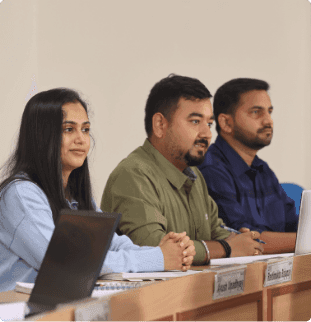
This two-year full time Programme in human resource management was launched in 1953 as Personal Management and Industrial Relations Programme. It is the oldest and the most prestigious of the institutes teaching programme. Ranked as the best programme in India and the Asia-Pacific region, it aims to equip the students with the knowledge and skills required for managing human resources in a way that contributes to the development of individuals and organizations.

This two-year full time programme on business management was launched in 1968 and is extremely prestigious and rated as one of the finest of its kind in the country. The BM programme is designed to closely integrate current management theory and practices. The course imparts knowledge and fosters attitudes essential for the growth of students into competent, responsible managers. The course has evolving programme content and is constantly updated to be in tune with the emerging trends.
We offer specializations in the following areas
- Industrial Relations
- Finance
- Organizational Behavior
- Personal Management
- Information Systems
- Sales and Marketing
- Operations
- Economics
- General Management
- Strategy
Academic Calendar
XLRI follows an academic calendar consisting of three trimesters of 10-12 weeks each in a year. Each term ends with the end-term examinations which is followed by a short holiday. The schedule stated below is tentative and the exact dates may have minor variations.The approximate periods of the trimesters are -
Summer trimester
- First term of the academic year
- Mid June to September
Fall trimester
- Second term of the academic year
- September to December
Spring trimester
- Third term of the academic year
- January to April
Course credits & Evaluation
The Institutes evaluation system emphasizes continuous assessment of a student against the required standards of academic achievement. Hence apart from the terminal examinations, the students performance is evaluated on the basis of class participation and preparation, periodic assignments, project, surprise quizzes and mid-term tests. Each credit corresponds to 10 contact hours. A student is expected to put in at least 100 hours of work in a three-credit (3) course which includes 30 contact hours in class. In the case of a one-and-a-half-credit (1.5) course, the time devoted should be 50 hours including 15 contact hours.
Course is evaluated and graded on a nine-point scale taking into consideration the student’s performance in different segments of evaluation mentioned above. The grades and their corresponding quality points are given below:
Rating | Fail | Poor | Average | Good | Excellent | ||||
|---|---|---|---|---|---|---|---|---|---|
Grade | F | D | D+ | C | C+ | B | B+ | A | A+ |
Quality Points | 0 | 1 | 2 | 3 | 4 | 5 | 6 | 7 | 8 |
Equivalent Marks | 0-34 | 35-42 | 43-50 | 51-58 | 59-66 | 67-74 | 75-82 | 83-90 | 91-100 |

Programme Pedagogy
These help in making the teaching learning process very interesting and effective. The medium of instructions for all the courses is English. The teaching methods include a diverse combination of the following:
Classroom lectures
Group work
Lecture series
Role plays
Simulation games and audio visuals
Industrial visit
Assignments
Case methods
Dissertation
Project work