- Director's Message
- About The Director
- Heritage
- Founding Fathers
- Brand XLRI
- Vision and Mission
- Board of Governors
- Leadership and Administration
- Industry Advisory Council
- Programs and Equivalence
- XLRI’s Position & Ranking
- Accreditation
- Social Initiatives
- Rural Immersion
- Social Engagement Activities
- Mandatory Disclosure
- Careers Opportunities
- Internal Committee
- Student Profile
- Batch Profile
- Our Recruiters
- Create Visibility for your Firm
- Placement Overview
- Career Transformation Series
- Placement Office Team - PGDM(GM)
- PGDM (GM) Student Committee
- Alumni Speak - PGDM (GM)
- Virtual Internship
- Professional Mentorship Programme
- Guest Lecture Series
- CXO Series
- XL Forum Series
- PGDM (GM) Annual Alumni Meet - Confluence
- Conclaves, Seminars & Panel Discussion
- FAQs
- Fr Arrupe Centre for Ecology and Sustainability
- Financial Market Centre
- Centre for Human Resource Development
- Centre for Logistics & SCM
- Centre for Peace and Justice
- XLRI JRD Tata Foundation in Business Ethics
- Centre for Gender Equality and Inclusive Leadership
- Center for Public Policy and Public Affairs
- XLRI Centre for Spirituality & Human Development
- Case Research & Simulation Development Centre
- Fr McGrath Skill Development Centre
- Centre for Entrepreneurship
- Centre for Learning and Teaching Innovations
- Centre of AI Research and Application (CARA)
- XCITE
- Centre for Experiential and Gamified Experiences (EDGE)
- Centre for Global South Studies
- Centre for Excellence in Coaching & Leadership (X-CEL)
- XCEED - XLRI Incubator

Introduction to Behavioral Labs
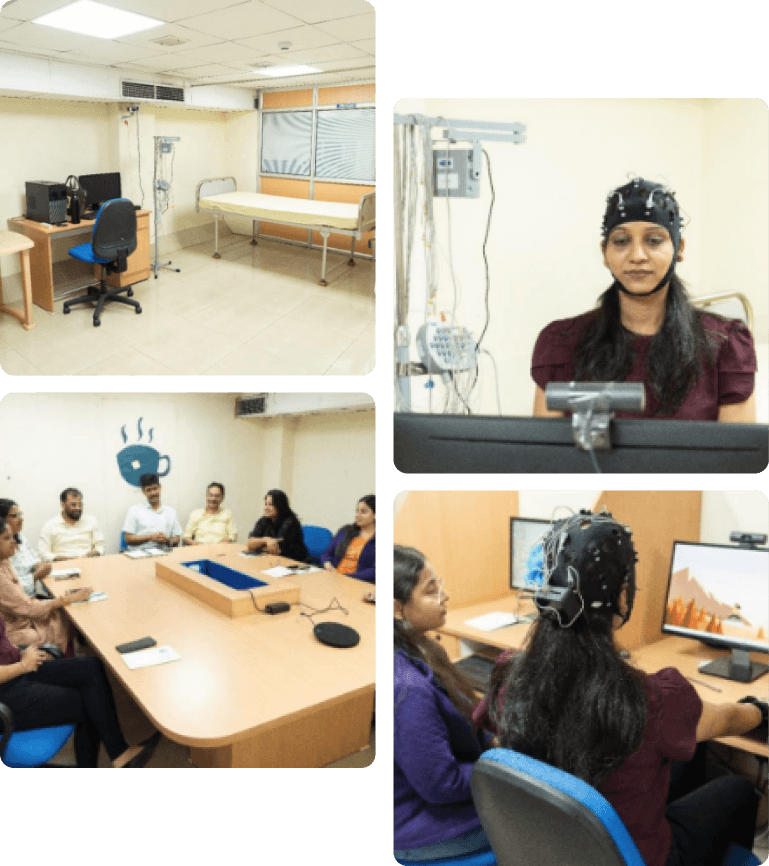
At XLRI Jamshedpur, the Centre for Neuromanagement & Behavioural Sciences pioneers the fusion of neuroscience, psychology, and management research to understand how humans think, decide, and lead. Through advanced technologies like EEG, eye-tracking, and physiological analytics, we decode the subtle interplay between cognition, emotion, and decision-making, translating these insights into better leadership, workplace design, and consumer understanding.
Why Neuromanagement?
Neuromanagement extends beyond traditional neuromarketing. It explores how neural and physiological processes shape leadership, teamwork, trust, ethics, consumer decision making, and innovation. By connecting the biology of the mind to the sociology of organizations, neuromanagement bridges the gap between what we know and how we act.
What We Do
Research & Discovery – Conduct cutting-edge experiments in leadership neuroscience, decision-making, and consumer cognition.
Application & Partnership – Collaborate with corporates, start-ups, and policy bodies.
Education & Engagement – Train the next generation of scholars and professionals in evidence-based management.
Avant Garde Research Equipment
An eye tracker is a device or technology used to measure eye movements, typically tracking where a person is looking (gaze point), how long they look at certain areas (fixation), and the sequence of eye movements. It helps researchers understand attention, interest, and cognitive processes by analyzing visual behavior.
An eye tracker is useful in a behavioral lab because it helps researchers understand how people pay attention, process information, and make decisions by tracking their eye movements. It provides objective data on where a person looks, how long they focus on certain areas, and in what order. This is valuable in studying attention, emotion, learning, social behavior, and mental health, making it a powerful tool in psychology, education, neuroscience, and human-computer interaction research.
A Wearable Eye Tracker is a lightweight, head-mounted device that records eye movements in real-world settings. It captures where and how long a person looks at specific objects or areas, providing detailed data on visual attention, gaze patterns, and focus.
In a behavioural lab, a wearable eye tracker is used to study how people visually interact with their surroundings in real-life situations. It helps researchers understand visual attention, decision-making, and consumer behaviour by tracking where and how long a person looks at specific objects.
A Wireless EEG (Electroencephalogram) is a portable device that records brain activity using sensors placed on the scalp without the need for wired connections. It measures electrical signals produced by neurons, allowing real-time monitoring of brain function.
In a behavioural lab, a wireless EEG is used to study brain responses during various tasks such as decision-making, emotional processing, attention, and memory. It helps researchers understand how consumers react to advertisements, products, or experiences at a neural level. Because it allows free movement, it is ideal for naturalistic experiments, making it valuable in neuromarketing, cognitive research, and human–computer interaction studies.
A Wireless ERP (Event-Related Potential) system is a portable tool that measures specific brain responses triggered by particular sensory, cognitive, or emotional events. It records time-locked electrical activity from the brain using wireless EEG technology, providing insight into how the brain processes different stimuli.
In a behavioural lab, a wireless ERP is used to study how individuals respond to specific events such as images, sounds, or advertisements. It helps researchers understand attention, perception, memory, and emotional reactions by analyzing the timing and strength of brain responses. This makes it especially useful in neuromarketing and cognitive psychology to assess how people unconsciously process information and make decisions.
ECG (Electrocardiogram), GSR (Galvanic Skin Response), EMG (Electromyography), and HR (Heart Rate) are physiological measurement tools used to record different aspects of the body’s responses. ECG measures the electrical activity of the heart, GSR tracks skin conductance related to emotional arousal, EMG records muscle activity, and HR monitors the rate of heartbeats.
In a behavioural lab, these tools are used to assess emotional and physiological reactions during various tasks or stimuli. They help researchers understand stress, excitement, relaxation, and engagement levels in participants. In neuromarketing studies, they reveal how consumers emotionally respond to advertisements, products, or experiences, providing valuable insights into subconscious reactions and decision-making processes.
An Automated Emotion Reader is a software-based system that detects and analyzes human emotions by interpreting facial expressions, voice tone, or physiological signals using artificial intelligence and computer vision technology.
In a behavioural lab, an automated emotion reader is used to measure participants’ emotional responses during experiments, advertisements, or product testing. It helps researchers identify subtle, real-time changes in emotions such as happiness, surprise, anger, or fear. This data is valuable in understanding consumer reactions, improving marketing strategies, and enhancing user experience design based on emotional feedback.
Polysomnography (PSG) is a comprehensive sleep study technique that records multiple physiological signals simultaneously, such as brain activity (EEG), eye movements (EOG), muscle activity (EMG), heart rate (ECG), breathing patterns, and oxygen levels, to assess sleep stages and disorders.
In a behavioural lab, polysomnography is used to study sleep patterns, quality, and the relationship between sleep and cognitive or emotional functioning. It helps researchers understand how sleep affects memory, attention, mood, and decision-making. In applied settings like neuromarketing or wellness research, PSG can also be used to evaluate how stress, lifestyle, or media exposure influences sleep and overall well-being.
E-volve Biofeedback is a system designed to monitor and train physiological responses such as heart rate, skin conductance, breathing, and muscle tension in real time. It provides visual or auditory feedback to help individuals become aware of and regulate their body’s stress and relaxation levels.
In a behavioural lab, E-volve Biofeedback is used to study how individuals control physiological and emotional states through self-regulation techniques. It helps in research on stress management, emotional regulation, and performance enhancement. In neuromarketing and psychology studies, it provides insights into how people react to stimuli and how relaxation or focus training can improve cognitive performance and emotional well-being.
E-Prime Perpetual is a software suite used for designing, running, and analyzing psychological and behavioral experiments. It allows precise control over stimulus presentation, timing, and response collection, making it ideal for cognitive, perceptual, and neuromarketing research.
In a behavioural lab, E-Prime Perpetual is used to create controlled experiments that study attention, memory, decision-making, and emotional responses. It enables researchers to present visual or auditory stimuli accurately, record participant reactions, and analyze data efficiently. This makes it valuable for testing hypotheses in cognitive psychology, consumer behavior, and neuromarketing studies.
The above facilities are complemented by the following
An observation room with one-way mirror, video camera and a seating capacity of 8-10 people. This room is ideal for running focus group interviews and conducting observation-based experiments. The data captured through online cameras can be analyzed by using various software.
Cabins for capturing individual responses. These cabins are equipped with a 21-inch monitor, a PC and time response software (Direct RT).
A conference room equipped with an LED screen can be used for debriefing the respondents or to conduct group exercises. This space can also be used for designing and conducting small experiments and has been provided with flexible furniture and partitions.
A server room providing facilities to store, edit and analyze experimental data. The lab is equipped with Media Lab software.
Lab also subscribes to Qualtrics, MATLAB, and other proprietary software applications.
The Brains
Behind Behavioural Lab
The B. Lab is managed by a Team of multidisciplinary experts drawn from various areas of expertise and experience.
Dr. Himadri Roy Chaudhuri
He has a substantive experience in the field of marketing academics and has a grounding in evolving market and human behaviour. His research features in international journals of high-repute that includes outlets, listed in Financial Times top 40. His work has been widely cited by accomplished scholars across the globe. He is regularly invited as a speaker to leading European universities. He currently serves as the Chair of the Department of Marketing at XLRI, Jamshedpur and heads the behavioral lab.
He can be reached at himadri@xlri.ac.in
Dr. Debasis Pradhan
His evidence-based research and teaching in marketing, consumer research, and brand management has been timely and impactful. His research is widely quoted in major business publications, and he regularly trains and offers consultancy services to large business conglomerates. He exhibits an eclectic mix of the rigour of academic research with a grounded understanding of the art of doing business. He is currently working as a Professor in the Department of Marketing, XLRI, Jamshedpur.
He can be reached at debasis@xlri.ac.in

Dr. Pooja Mohanty
Trained as a clinical psychotherapist at NIMHANS(National Institute of Mental Health and Neuroscience, Bangalore, India) and the University of Oxford, UK she has an exemplary understanding of human behaviour and psycho pathology. With a rich experience of handling over ten thousand cases, she provides a superior understanding of art and science of human behavior management ensuring effective performance at work and beyond.
She can be reached at poojamohanty@xlri.ac.in
Dr Tapas R Moharana
He is widely acknowledged for his cutting-edge knowledge in marketing science and research methods. He is widely cited in business publications and is regarded as an expert in field research. Dr. Moharana is currently working as an Assistant Professor in the Department of Marketing, XLRI, Jamshedpur.
He can be reached at trmoharana@xlri.ac.in
Barkha Gabri
She is a psychologist with over five years of clinical experience, specializing in the assessment and management of a wide spectrum of psychological and behavioural concerns. Her professional work explores the intricate relationship between cognition, emotion, and behaviour, drawing on evidence-based frameworks to foster psychological well-being. At the Behaviour Lab, she is involved in advancing the scientific understanding of human behaviour through research and applied inquiry. Her interests lie in behavioural modification, emotional regulation, and the integration of clinical perspectives within experimental and therapeutic contexts.
She can be reached at barkha@xlri.ac.in
Fr Joseph Mathew, S J
He is well versed in such advanced methodologies such as EEG, event-related potentials (ERP), eye-tracking, and various psychometric tools. His interests are in applied behavioural psychology and therapeutic interventions, focusing on methodologies and models that transform individuals and communities. He is an expert on Mindfulness-Based Cognitive Therapy (MBCT), Mindfulness-Based Stress Reduction (MBSR), Emotion-Focused Therapy (EFT), and Spirituality for enhancing emotional processing and well-being.
He can be reached at joseph@xlri.ac.in
Rajyashree
Professionally trained in clinical laboratory management with expertise in resource allocation for services such as USG and EEG. Proficient in patient safety, equipment management, record keeping, and maintenance, and recognized for reliability, precision, and ethical conduct with the ability to manage high patient volumes efficiently.